Our expert team is here to guide you every step of the way, and helping you to navigate the complexities of your Personal and Business Compliances.
Call To ExpertBelow are the main advantages of sole proprietorship registration in India:
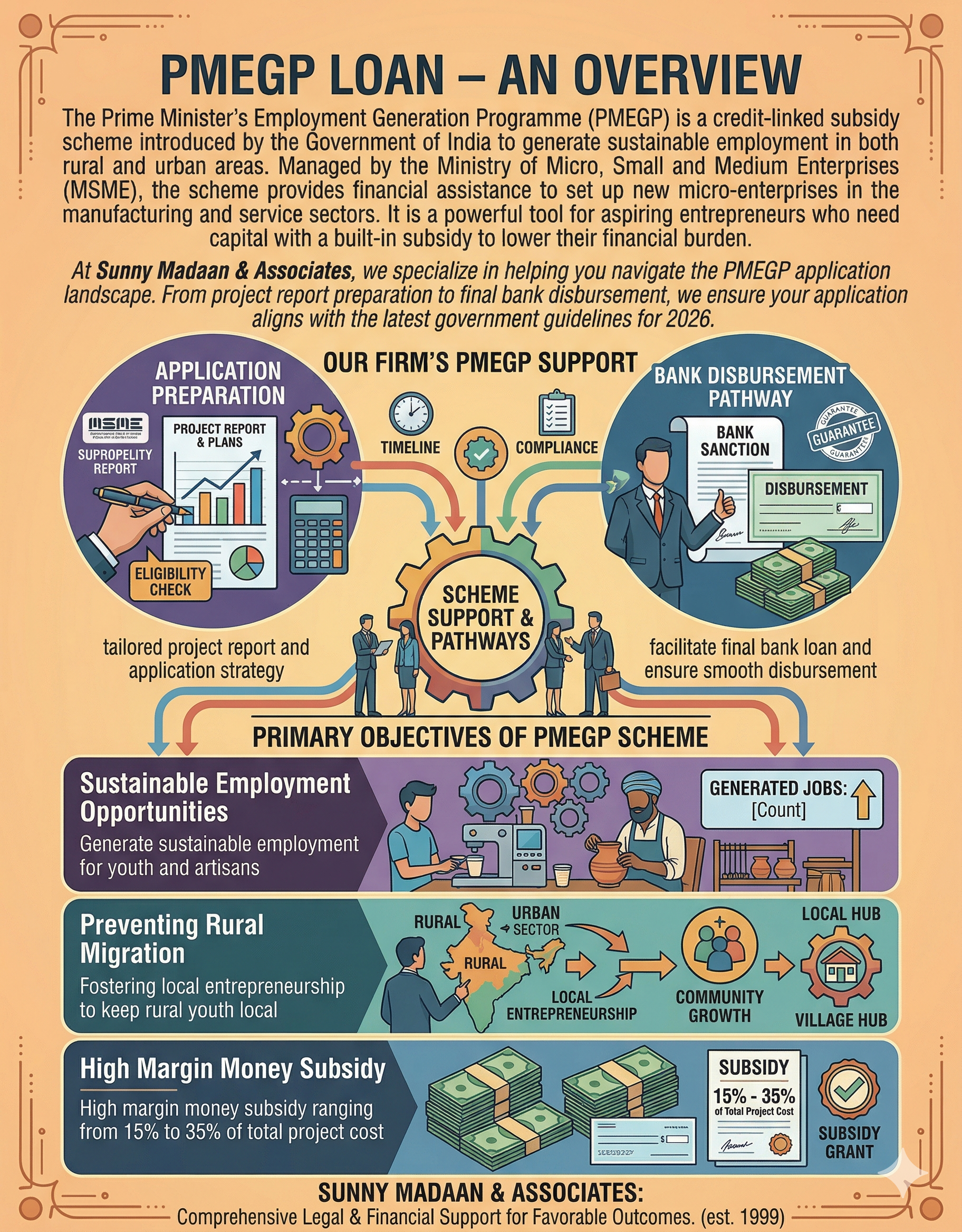
The Prime Minister’s Employment Generation Programme (PMEGP) is a credit-linked subsidy scheme introduced by the Government of India to generate sustainable employment in both rural and urban areas. Managed by the Ministry of Micro, Small and Medium Enterprises (MSME), the scheme provides financial assistance to set up new micro-enterprises in the manufacturing and service sectors. It is a powerful tool for aspiring entrepreneurs who need capital with a built-in subsidy to lower their financial burden.
At Sunny Madaan & Associates, we specialize in helping you navigate the PMEGP application landscape. From project report preparation to final bank disbursement, we ensure your application aligns with the latest government guidelines for 2026.
The primary objectives of the PMEGP scheme are:
To generate sustainable employment opportunities for unemployed youth and traditional artisans.
To prevent rural migration to cities by fostering local entrepreneurship.
To provide a high margin money subsidy ranging from 15% to 35% of the total project cost.
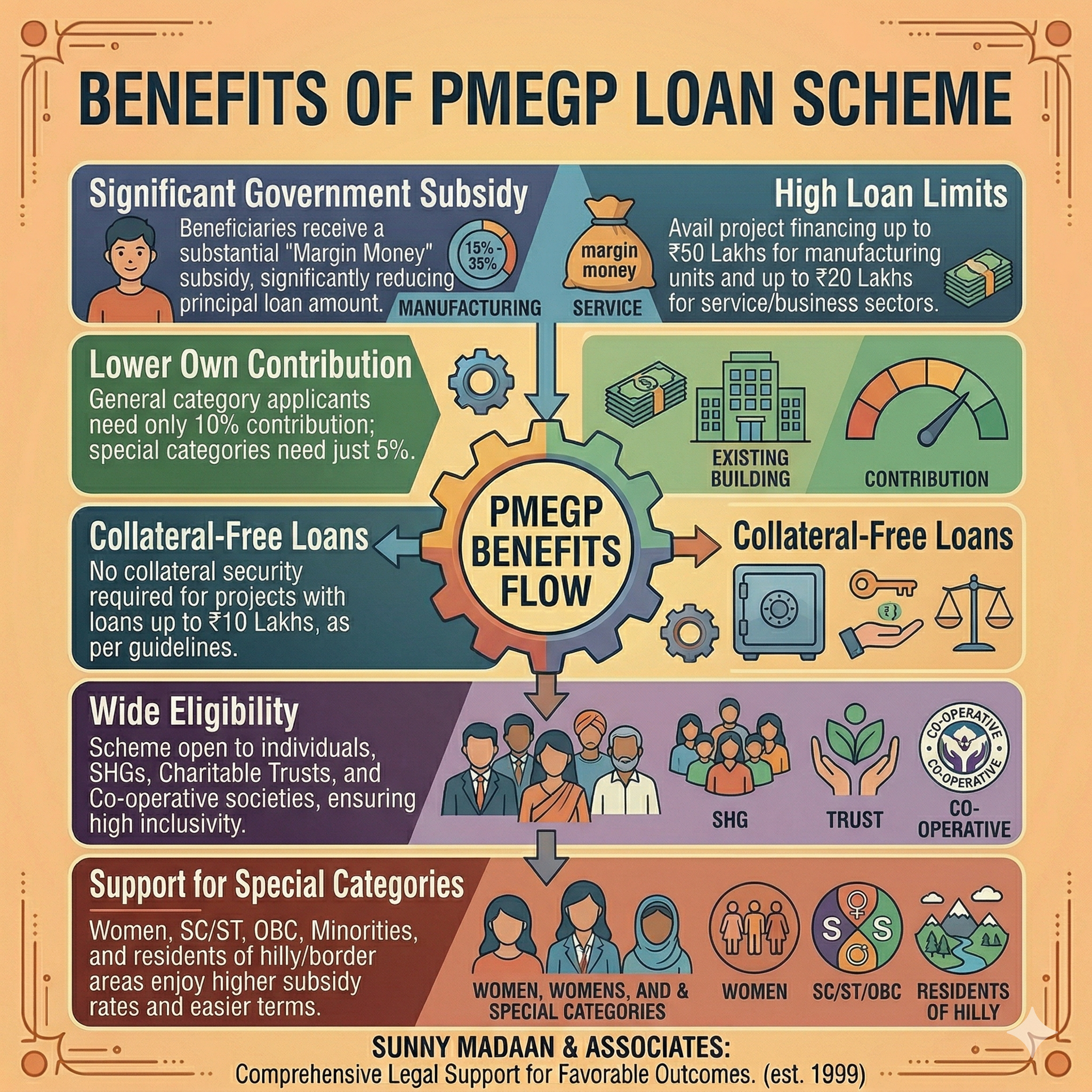
Significant Government Subsidy: Beneficiaries receive a “Margin Money” subsidy of 15% to 35%, which reduces the principal loan amount significantly.
High Loan Limits: You can avail of project financing up to ₹50 Lakhs for manufacturing units and up to ₹20 Lakhs for service or business sectors.
Lower Own Contribution: General category applicants only need to contribute 10% of the project cost, while special categories contribute just 5%.
Collateral-Free Loans: As per RBI guidelines, no collateral security is required for projects involving loans up to ₹10 Lakhs.
Wide Eligibility: The scheme is open to individuals, SHGs, Charitable Trusts, and Co-operative societies, making it highly inclusive.
Support for Special Categories: Women, SC/ST, OBC, Minorities, and residents of hilly or border areas enjoy higher subsidy rates and easier terms.
To qualify for the PMEGP loan and subsidy, the following criteria and documentation are required:
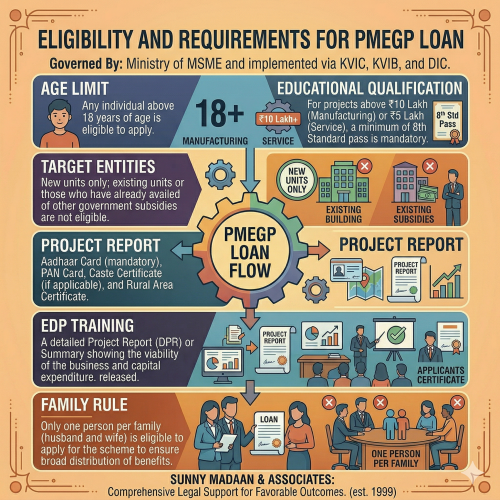
Governed By: Ministry of MSME and implemented via KVIC, KVIB, and DIC.
Age Limit: Any individual above 18 years of age is eligible to apply.
Educational Qualification: For projects above ₹10 Lakh (Manufacturing) or ₹5 Lakh (Service), a minimum of 8th Standard pass is mandatory.
Target Entities: New units only; existing units or those who have already availed of other government subsidies are not eligible.
Essential Documents: Aadhaar Card (mandatory), PAN Card, Caste Certificate (if applicable), and Rural Area Certificate.
Project Report: A detailed Project Report (DPR) or Summary showing the viability of the business and capital expenditure.
EDP Training: Successful applicants must undergo Entrepreneurship Development Programme (EDP) training before the subsidy is released.
Family Rule: Only one person per family (husband and wife) is eligible to apply for the scheme to ensure broad distribution of benefits.
The following documents required for PMEGP Loan Application Process :
The process begins with an online application on the KVIC portal. We help you validate your Aadhaar and select the correct implementing agency (DIC, KVIC, or KVIB) based on your location.
We assist in drafting a professional Project Report that meets bank standards. All required documents, including educational certificates and category proofs, are scanned and uploaded to the portal.
Your application is reviewed by the District Level Task Force Committee (DLTFC). You may be called for a brief interview to discuss the feasibility and potential of your business idea
Once cleared by the committee, the application is forwarded to the bank. The bank performs its due diligence and issues a sanction letter for the term loan and working capital.
After the loan is sanctioned, you must complete the mandatory EDP training. The government then releases the “Margin Money” subsidy, which is kept in a 3-year TDR before being adjusted against your loan.
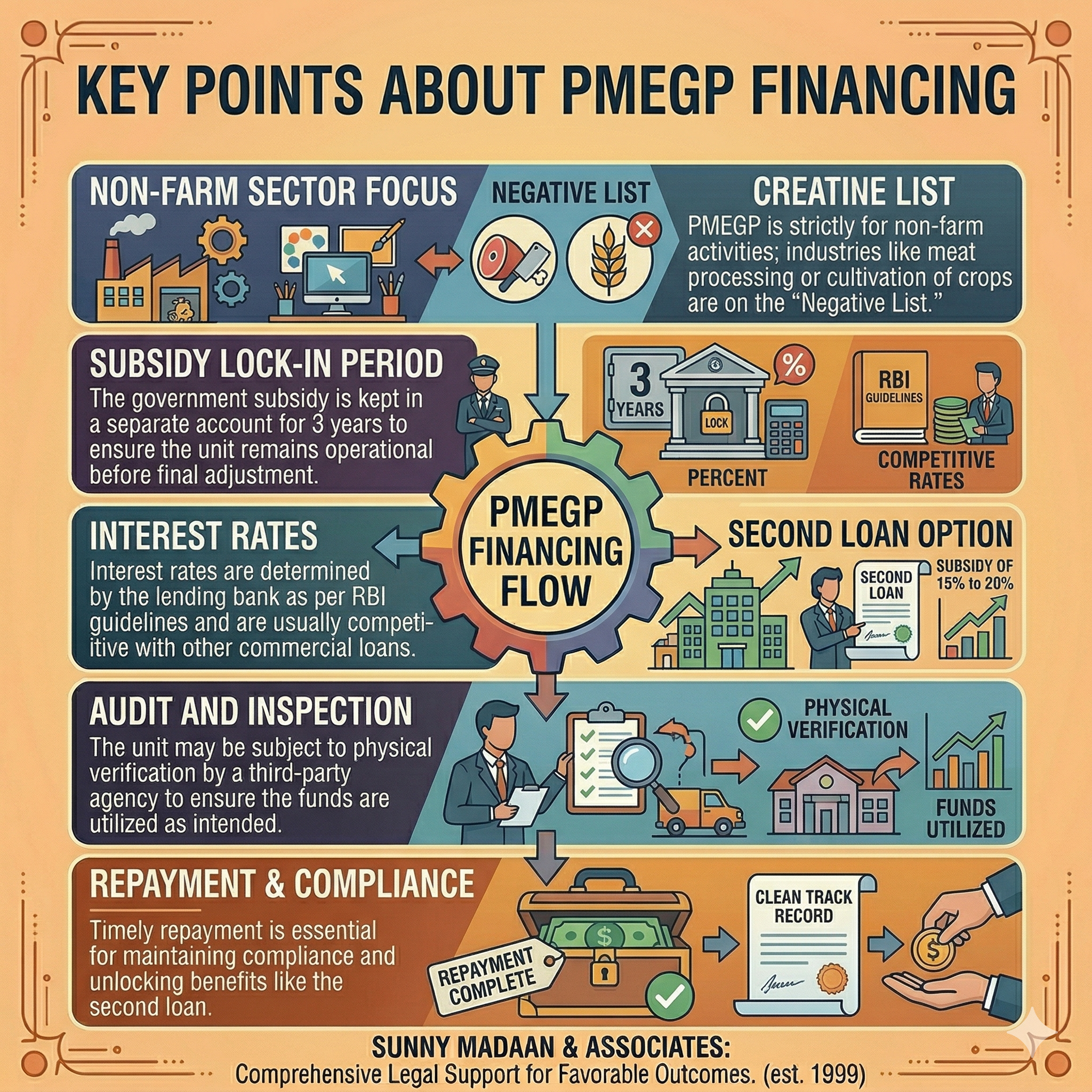
Key Points about PMEGP Financing
Â
Non-Farm Sector Focus: PMEGP is strictly for non-farm activities; industries like meat processing or cultivation of crops are on the “Negative List.”
Subsidy Lock-in Period: The government subsidy is kept in a separate account for 3 years to ensure the unit remains operational before final adjustment.
Interest Rates: Interest rates are determined by the lending bank as per RBI guidelines and are usually competitive with other commercial loans.
Second Loan Option: Performant units that have repaid their first loan can apply for a second loan for expansion with a subsidy of 15% to 20%.
Audit and Inspection: The unit may be subject to physical verification by a third-party agency to ensure the funds are utilized as intended.
No, the cost of land cannot be included in the project cost. However, the cost of a ready-built shed or the lease/rental for a workshop for up to 3 years can be included.
Women are considered under the “Special Category.” In rural areas, you are eligible for a 35% subsidy, and in urban areas, a 25% subsidy of the project cost.
Typically, the process from online application to loan disbursement takes 3 to 6 months, depending on the committee’s meeting schedule and the bank’s internal processing.
Â
Yes, EDP training is mandatory for all PMEGP beneficiaries to ensure they have the necessary skills to manage a business, though certain exemptions exist for those with prior vocational training.