Our expert team is here to guide you every step of the way, and helping you to navigate the complexities of your Personal and Business Compliances.
Call To ExpertA partnership firm is a popular business structure commonly chosen by newly established businesses in India. It requires a minimum of two partners to be formed.
The formalization of a partnership firm is done through a partnership deed an important document that outlines the terms and conditions agreed upon by the partners. This deed serves as a guide for managing the firm’s operational and financial arrangements, ensuring clarity and mutual understanding among the partners.
The checklist for registering a partnership firm in India includes:
Â
Finalize Partners: Minimum of two partners are required to start the firm.
Select a Name: Choose a unique name for your partnership firm that does not infringe on existing trademarks.
Draft Partnership Deed: Prepare a formal agreement outlining profit-sharing, capital contribution, and roles.
Business Address: Identify a registered office address for the firm.
Apply for PAN & TAN: Obtain a dedicated Permanent Account Number and Tax Deduction Account Number in the firm’s name.
Registration (Optional but Recommended): While not mandatory, registering with the Registrar of Firms (RoF) provides legal benefits.
The eligibility criteria for partnership registration are:
Â
Minimum Partners: At least two individuals are required.
Maximum Partners: The limit is generally 50 partners under the Companies Act.
Competency to Contract: Every partner must be of sound mind, a major (above 18), and not disqualified by any law.
Lawful Object: The business must be formed for a legal purpose or trade.
Profit Sharing: There must be a clear intent to share profits earned from the business.
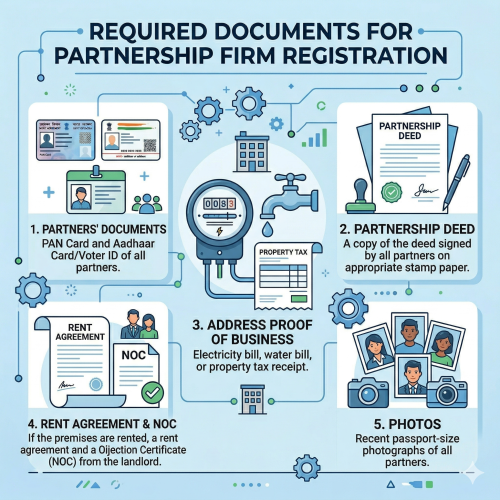
The following documents are required for Partnership Registration:
Â
Partners’ Documents: PAN Card and Aadhaar Card/Voter ID of all partners.
Partnership Deed: A copy of the deed signed by all partners on appropriate stamp paper.
Address Proof of Business: Electricity bill, water bill, or property tax receipt.
Rent Agreement & NOC: If the premises are rented, a rent agreement and a No Objection Certificate (NOC) from the landlord.
Photos: Recent passport-size photographs of all partners.
After registration, a partnership firm must adhere to these ongoing requirements:
 Partnership firms must file an ITR-5 every financial year, regardless of profit or loss.
 If the firm is GST-registered, regular monthly or quarterly returns must be filed.
If the firm pays salaries or professional fees, it must deduct and file TDS returns.
If the turnover exceeds the limits specified under the Income Tax Act, a tax audit by a Chartered Accountant is mandatory.
 Keeping updated minutes of meetings (if applicable) and accurate books of accounts.
Unlike a sole proprietorship, a partnership firm is treated as a separate legal entity for tax purposes:
Â
Partnership firms are generally taxed at a flat rate of 30% on their total income (plus applicable surcharge and cess).
Salaries and interest paid to partners are deductible expenses for the firm (subject to limits under Section 40(b)).
 Share of profit received by partners from the firm is exempt from tax in the hands of the partners, as the firm has already paid tax on it.
What is the minimum number of partners required?
A minimum of two partners is required to form a partnership firm.
No, registration under the Indian Partnership Act, 1932 is optional. However, an unregistered firm cannot sue third parties or other partners in court for enforcing rights.
Yes, a body corporate (like a Private Limited Company) can be a partner in a partnership firm.
Yes, the deed can be amended at any time by creating a Supplementary Deed and filing it with the Registrar of Firms.
Yes, a partnership firm must apply for a separate PAN card in the name of the firm.