Our expert team is here to guide you every step of the way, and helping you to navigate the complexities of your Personal and Business Compliances.
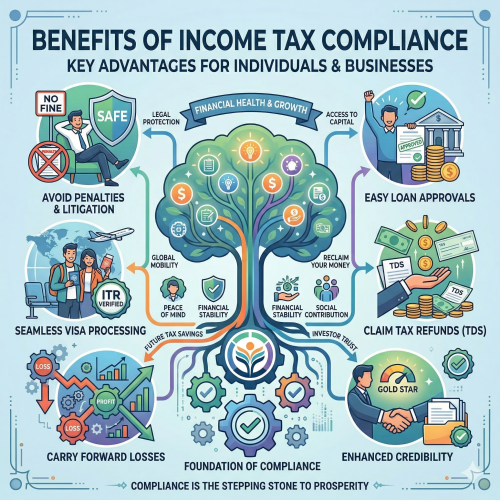
Call To ExpertBelow are the main advantages of income tax compliance in India:
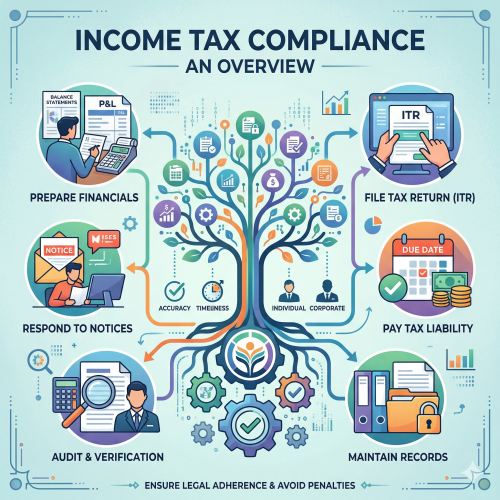
Income Tax Compliance refers to the adherence to the rules and regulations set by the Income Tax Act, 1961. It is a mandatory process for every taxpayer, including individuals, firms, and companies, to report their annual income and pay the corresponding taxes to the government. Compliance is not merely a legal obligation but a financial responsibility that ensures the smooth functioning of your business and personal financial health. The Department grants various exemptions and deductions to taxpayers who maintain transparent records and timely filings. There are three main conditions for maintaining high compliance.
The taxpayer should report all sources of income accurately.
Advance tax and self-assessment tax should be paid on time.
The taxpayer should file annual returns before the statutory deadlines.
Maintaining rigorous income tax compliance is more than just a legal obligation; it is a strategic financial advantage. By adhering to tax laws and deadlines, individuals and businesses can ensure long-term stability and growth.
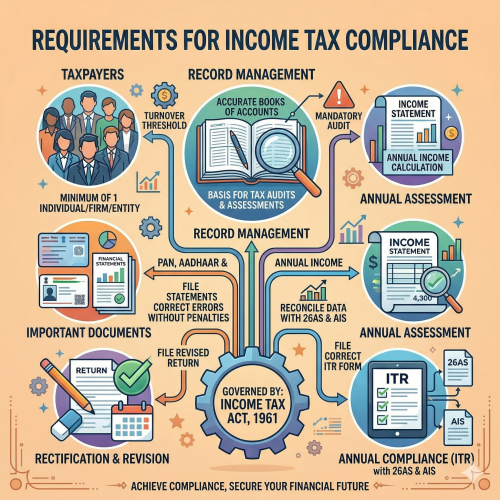
For the Income Tax Compliance procedure, the following criteria must be fulfilled:
Governed By: Income Tax Act, 1961
Taxpayers: Minimum of 1 Individual/Firm/Entity
Important Documents: PAN, Aadhaar, and Financial Statements
Assessment: Annual Income calculation
Record Management: All financial transactions belonging to the taxpayer must be recorded accurately in books of accounts. These records serve as the basis for tax audits and assessments as per the provisions mentioned in the Income Tax Act. The Act says audits are mandatory when the business turnover exceeds the specified threshold limits set by the government.
Rectification and Revision: If an error is found in the filed return, the taxpayer has the right to file a revised return within the allowed timeframe. This ensures that the tax records remain accurate and any settlement of liabilities is done without initiating legal disputes or penalties.
Annual Compliance: The taxpayer must ensure its annual compliance by filing the correct ITR form and reconciling data with Form 26AS and AIS.
The following process for Income Tax Compliance :
Gather all necessary documents including bank statements, salary slips, investment proofs, and TDS certificates. Ensure your PAN and Aadhaar are linked for seamless digital processing.
Calculate the total gross income from all sources like salary, business, capital gains, or house property. Deduct eligible investments under Chapter VI-A to arrive at the taxable income.
Â
Cross-verify the tax deducted (TDS) with Form 26AS and the Annual Information Statement (AIS). Ensure all taxes paid are correctly reflected on the government’s e-filing portal.
Â
Select the appropriate ITR form based on your income profile. Submit the data on the Income Tax Department portal and perform the mandatory e-verification using Aadhaar OTP or EVC.
Upon successful filing and verification, the department processes the return. You will receive an intimation under Section 143(1) confirming the final tax liability or the refund amount.
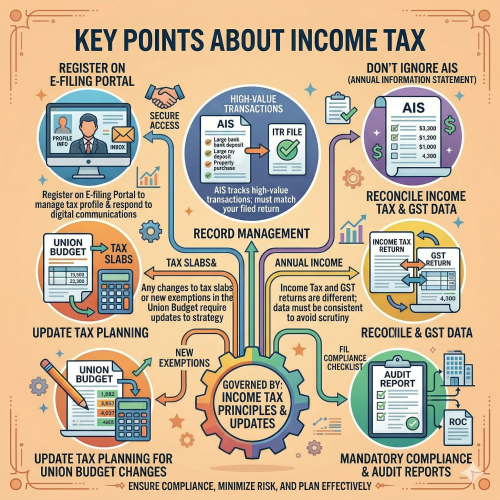
Key Points about Income Tax
Taxpayers in India must register on the e-filing portal to manage their tax profile and respond to any digital communications from the department.
Taxpayers cannot ignore the Annual Information Statement (AIS) as it tracks all high-value transactions and must match with your filed return.
Income Tax Returns are different from GST returns; however, the data in both must be consistent to avoid scrutiny from the tax authorities.
Compliance with the Income Tax Act is mandatory for all profitable entities, including maintaining audit reports and filing returns with the ROC where applicable.
Any changes to the tax slab or new exemptions introduced in the Union Budget require immediate updates to your tax planning and compliance strategy.
No, regular compliance often leads to lower tax liability by identifying all eligible deductions and avoiding expensive late fees and interest penalties.
There is no minimum capital. However, anyone with a total income exceeding the basic exemption limit (e.g., ₹2.5 Lakhs or ₹3 Lakhs) must file a return.
Not necessarily. GST registration depends on your business turnover, whereas Income Tax depends on your total annual income from all sources combined.
Â
You can check the status of your filing by logging into the Income Tax e-filing portal. The status will show “Processed” once the department verifies your data.