Welcome to Sunny Madaan & Associates.

Our expert team is here to guide you every step of the way, and helping you to navigate the complexities of your Personal and Business Compliances.

Call To Expert

Let's discuss with your concern.


Our Social Networks
Civil Litigation & Dispute Resolution - An Overview

Below are the main advantages of sole proprietorship registration in India:

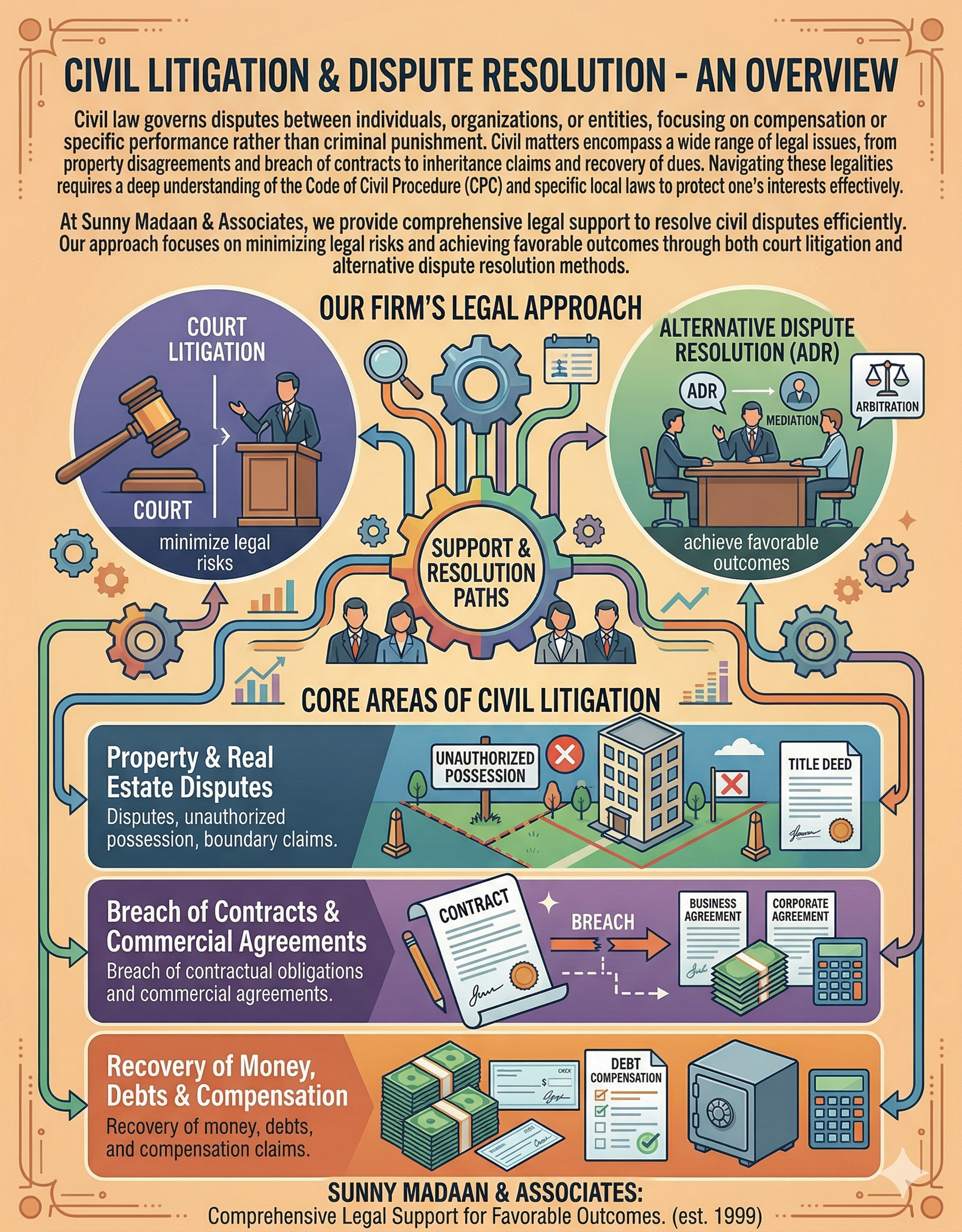
Civil law governs disputes between individuals, organizations, or entities, focusing on compensation or specific performance rather than criminal punishment. Civil matters encompass a wide range of legal issues, from property disagreements and breach of contracts to inheritance claims and recovery of dues. Navigating these legalities requires a deep understanding of the Code of Civil Procedure (CPC) and specific local laws to protect one’s interests effectively.

At Sunny Madaan & Associates, we provide comprehensive legal support to resolve civil disputes efficiently. Our approach focuses on minimizing legal risks and achieving favorable outcomes through both court litigation and alternative dispute resolution methods.

The core areas of civil litigation include:

  • Property and Real Estate disputes, including unauthorized possession.

  • Breach of contractual obligations and commercial agreements.

  • Recovery of money, debts, and compensation claims.

Civil Matter

Benefits of Expert Civil Legal Representation

Expert Civil Legal Representation

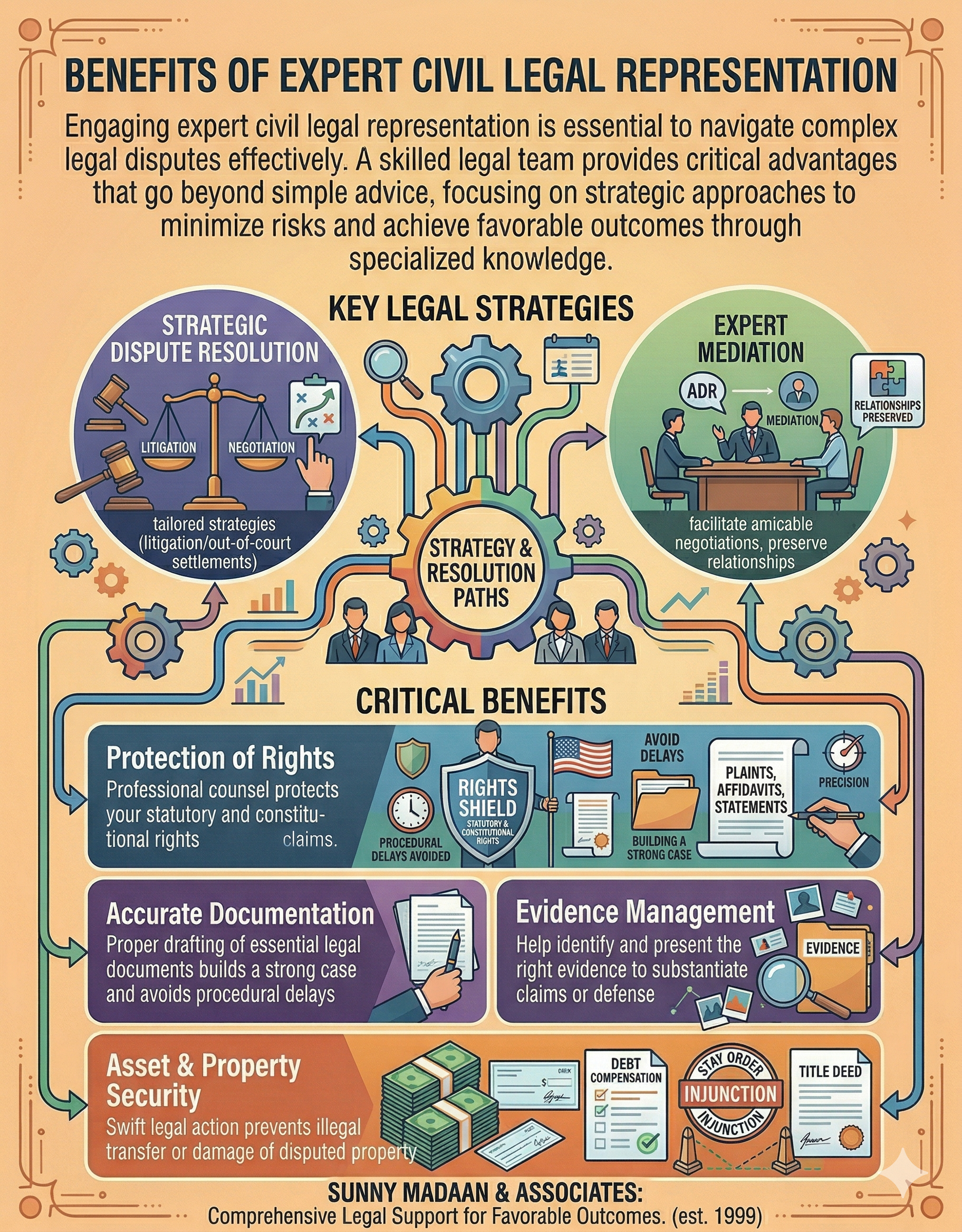
  • Protection of Rights: Professional legal counsel ensures that your statutory and constitutional rights are protected throughout the legal proceedings.
  • Strategic Dispute Resolution: We provide tailored strategies, whether through aggressive litigation or out-of-court settlements, to save time and resources.
  • Accurate Documentation: Proper drafting of plaints, written statements, and affidavits is crucial to building a strong case and avoiding procedural delays.
  • Asset & Property Security: Swift legal action, such as obtaining stay orders or injunctions, helps prevent the illegal transfer or damage of disputed property.
  • Expert Mediation: We facilitate negotiations to resolve disputes amicably, preserving professional or personal relationships while securing your interests.
beniifts of civil matter

Requirements for Initiating a Civil Suit

To pursue or defend a civil matter effectively, the following elements and documentation are generally required:

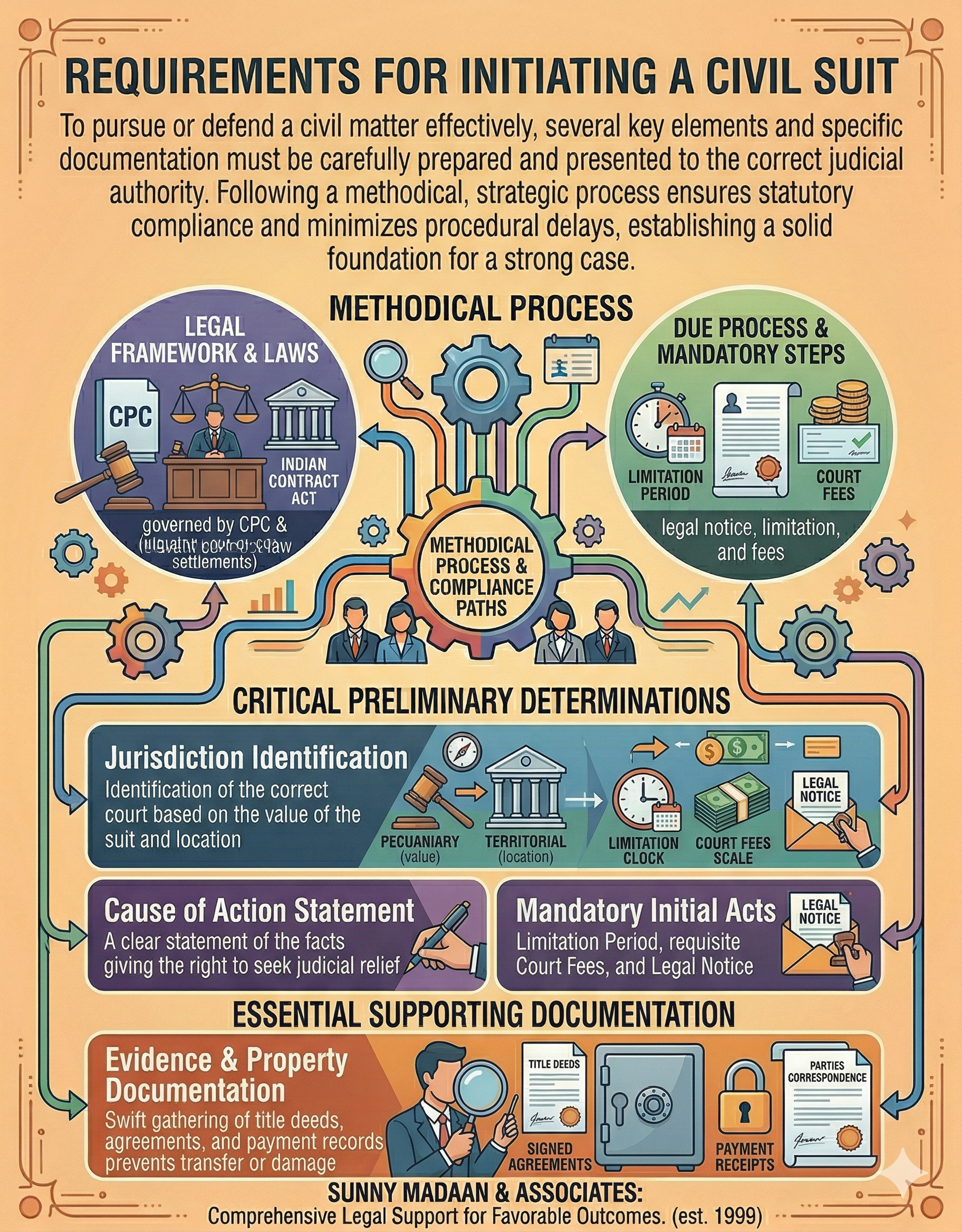
  • Governed By: The Code of Civil Procedure (CPC), 1908 and Indian Contract Act.

  • Jurisdiction: Identification of the correct court based on the value of the suit (Pecuniary) and location (Territorial).

  • Cause of Action: A clear statement of the facts that give the person the right to seek judicial relief.

  • Essential Documents: Title deeds, signed agreements, payment receipts, and correspondence between parties.

  • Limitation Period: The suit must be filed within the timeframe prescribed by the Limitation Act for that specific category of dispute.

  • Court Fees: Payment of the requisite court fees based on the nature and valuation of the relief sought in the suit.

  • Legal Notice: In many cases, serving a formal legal notice to the opposing party is a mandatory or recommended first step before litigation.

The Civil Litigation Process

The following documents required for The Civil Litigation :

Step 1: Drafting and Serving a Legal Notice

The process usually begins by sending a formal legal notice to the other party, clearly stating the grievances and the relief sought, providing them a chance to resolve the issue.

Step 2: Filing of the Plaint

If no resolution is reached, a “Plaint” is drafted and filed in the appropriate court. This document outlines the facts of the case and the specific legal remedy requested.

Step 3: Summons and Written Statement

The court issues a summons to the defendant. The defendant must then file a “Written Statement” (reply) responding to each allegation made in the plaint.

Step 4: Replication and Framing of Issues

The plaintiff may file a replication to answer the defendant’s statement. The court then identifies the core points of dispute, known as “Framing of Issues.”

Step 5: Evidence and Final Arguments

Both parties present their witnesses and documents for examination and cross-examination. After the evidence phase, the lawyers present final oral arguments before the judge passes a judgment.

Key Points about Civil Matters

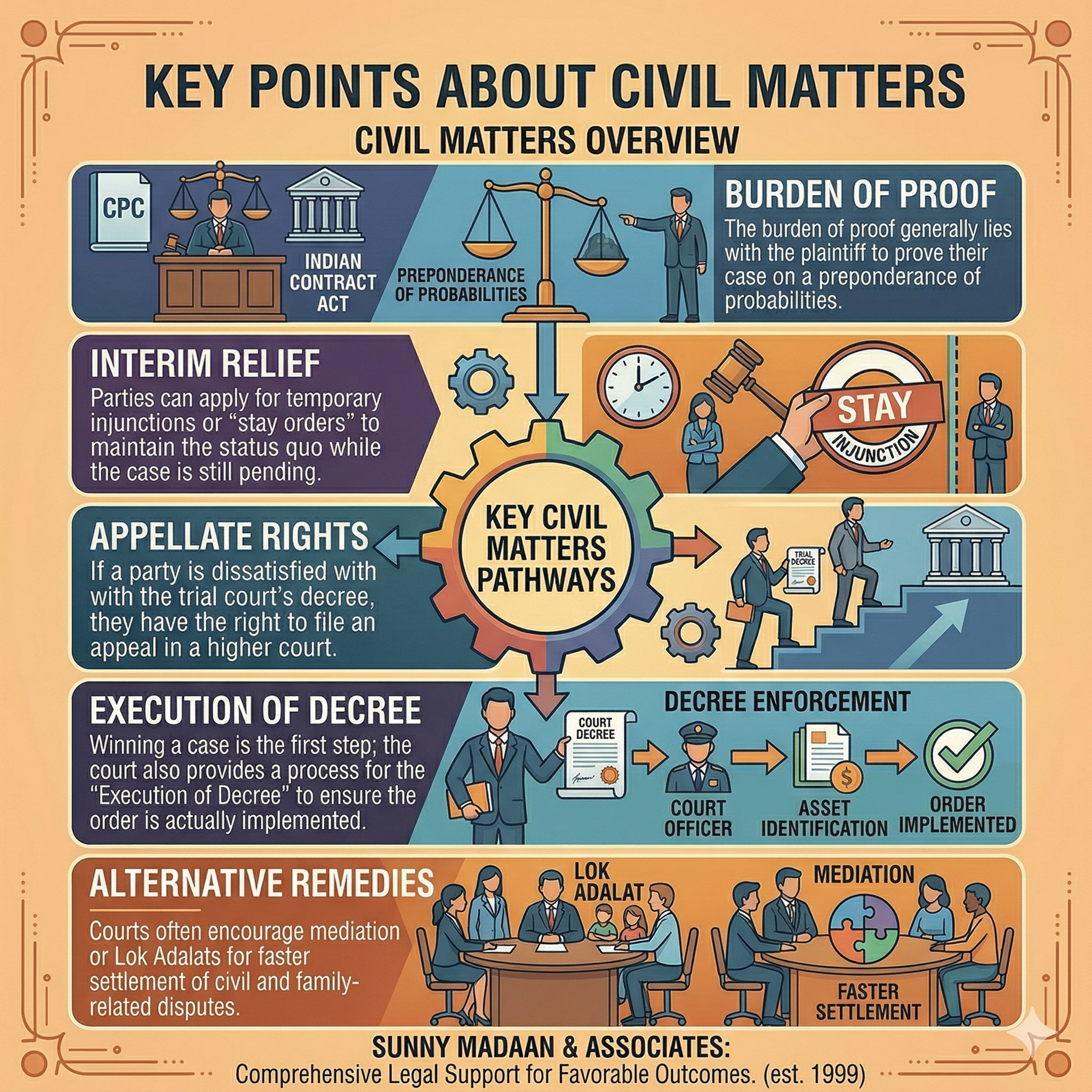
  • Burden of Proof: In civil cases, the burden of proof generally lies with the plaintiff to prove their case on a “preponderance of probabilities.”

  • Interim Relief: Parties can apply for temporary injunctions or “stay orders” to maintain the status quo while the case is still pending.

  • Appellate Rights: If a party is dissatisfied with the trial court’s decree, they have the right to file an appeal in a higher court.

  • Execution of Decree: Winning a case is the first step; the court also provides a process for the “Execution of Decree” to ensure the order is actually implemented.

  • Alternative Remedies: Courts often encourage mediation or Lok Adalats for faster settlement of civil and family-related disputes.

FAQs on Civil Matter

How long does a civil suit typically take to resolve?

The duration varies based on the complexity of the case and the court’s schedule. However, seeking interim relief can provide immediate protection while the final trial continues.

Can a civil matter be settled outside of court?

Yes, parties can opt for an out-of-court settlement at any stage of the proceedings through a compromise deed, which can then be recorded by the court.

What is the difference between a civil and criminal case?

A civil case deals with disputes between private parties over rights and duties, whereas a criminal case involves acts against the state or public, resulting in punishment.


What happens if the defendant does not appear in court?

If the defendant fails to appear after being duly served with a summons, the court may proceed “Ex-Parte,” meaning it may decide the case based only on the plaintiff’s evidence.